Practical Guide
This article is written for NSW tyre shops, workshops, dealers, warehouses, and fleet depots that want cleaner operations, easier pickups, and stronger compliance routines.
Why dealer groups need one tyre pickup rule
Dealer groups and franchise networks do not usually fail because they lack a recycler. They fail because each branch develops its own habit. One site books early, another waits until the yard is full, a third keeps records in a different place, and the fourth stores tyres wherever there is space.
That inconsistency creates avoidable friction. Pickup becomes harder to plan, managers spend more time chasing information, and the network loses the clean, repeatable pattern that makes commercial tyre collection predictable.
What a standard dealer collection system should cover
A good network-wide system does not need to be complicated. It needs a clear rule for when tyres are booked, where they are staged, and how each branch records the collection.
- Pickup trigger: define the volume, time interval, or manager approval point that starts a booking.
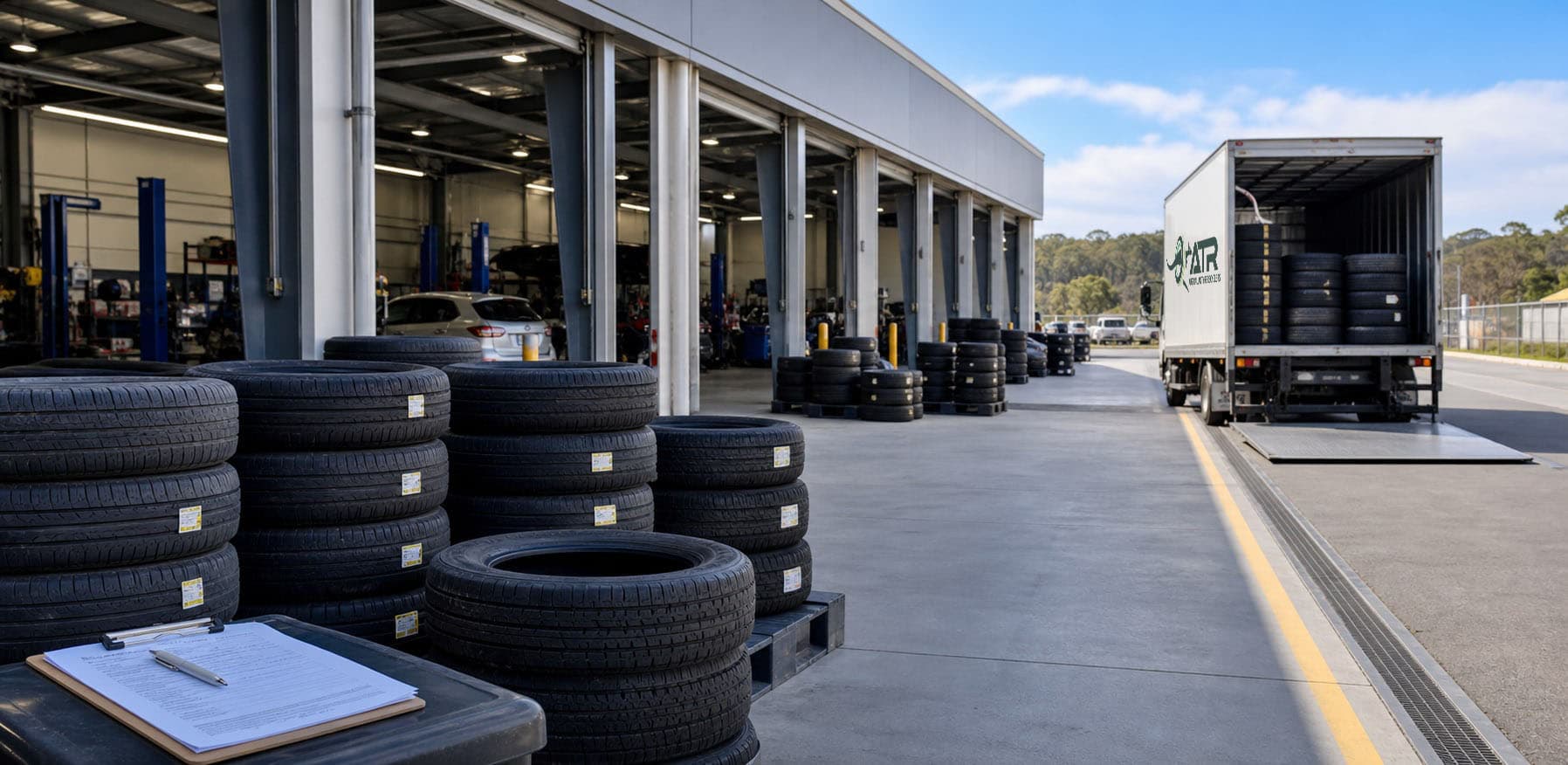
- Standard staging zone: every branch should use the same type of tyre area so collection-ready stock is easy to identify.
- Record format: collection dates, references, and branch notes should be stored in the same way across the network.
- Overflow rule: branches should know what to do when stock rises faster than normal between pickups.
- Review cadence: the head office or operations team should review pickup patterns monthly or quarterly.
Best fit for dealer networks
- Franchise groups with multiple NSW branches
- Dealer groups comparing branch performance centrally
- Workshops that sit inside a larger retail network
- Sites that want the same records everywhere
What happens without standardisation
- Different branches book at different thresholds
- Managers cannot compare sites easily
- Records are scattered across email and text threads
- Overflow becomes a recurring branch-by-branch problem
What should stay the same across every branch
The smartest dealer networks do not force every branch into the exact same volume timing. Sites do have different output. What they do standardise is the operating rule around storage, escalation, and records.
A small regional branch and a high-volume metro site may need different pickup frequency, but both should use the same approach for staging, booking, and documentation. That makes reporting cleaner and branch comparisons more meaningful.
Questions dealer managers should ask a provider
Before choosing a tyre collection partner for a network, ask questions that reveal whether the service can support more than one site.
- Can you support multiple NSW branches? the provider should understand network work, not only single-site pickup.
- Can the same records be provided for every branch? head office needs consistency for internal review.
- Can pickup frequency vary by site? good providers can adjust to each branch while keeping the reporting model stable.
- Do you support scheduled and bulk collections? dealer groups often need both.
- How do you handle overflow or inherited stock? some branches need a one-off reset before they can move to a steady rhythm.
Dealer mistakes that make tyre collection messy
Most network problems come from inconsistent branch habits, not from the recycler itself. The business can tighten those habits quickly if it knows where the weak points are.
- One branch, one process: every branch invents its own way to book and stage tyres.
- No central visibility: head office cannot tell which site is slipping or which site is over-producing.
- Records split everywhere: invoices, pickup references, and branch notes live in different places.
- Pickup only when full: the network waits for overflow instead of using a proactive cadence.
- No shared escalation rule: staff do not know when to call for help or move to a bulk clear-out.
Standardise the system, not just the pickup
Dealer tyre collection in NSW works best when the network treats disposal as a repeatable operating system. Standardise the trigger, standardise the records, and standardise the site setup so each branch can stay under control without reinventing the process.
If your network needs a recurring collection model, review Multi-Site Tyre Collection in NSW. For dealership sites with daily volume, compare Used Tyre Collection for Tyre Shops in NSW and Used Tyre Collection NSW. If the issue is overflow or a one-off clear-out, see Tyre Disposal for Businesses NSW, Commercial Tyre Disposal NSW, or contact ATR Eco.
Common Questions
Common questions about Dealer Group Tyre Collection in NSW: How Dealerships Standardise Pickup Across Sites
How should dealer groups standardise tyre collection across NSW branches?
Dealer groups should use one pickup trigger, one staging standard, and one record format across every branch, while allowing pickup frequency to vary based on each site's actual tyre volume.
Can each dealership branch have a different pickup schedule?
Yes. High-volume metro branches may need more frequent collection than smaller regional sites. The important part is keeping the booking rule, staging setup, and collection records consistent across the network.
What records should dealership managers keep after tyre pickup?
Managers should keep the pickup date, branch name, approximate tyre volume, collection reference, invoice details, and any notes about overflow, access, or mixed stock.
When should a dealer group book bulk tyre collection instead of scheduled pickup?
Bulk tyre collection is usually better when a branch has inherited stock, overflow outside the normal staging area, or a one-off reset volume that would disrupt the regular pickup cadence.
Next Step
Turn the guidance into a workable pickup plan
If you are reviewing tyre collection providers, compare the commercial tyre pickup services, the dedicated used tyre collection NSW page, or the broader tyre disposal for businesses NSW page. You can also request a site-specific collection plan through ATR contact, or review local coverage for Sydney, Newcastle, Wollongong, Central Coast, and Blue Mountains.