Practical Guide
This article is written for NSW tyre shops, workshops, dealers, warehouses, and fleet depots that want cleaner operations, easier pickups, and stronger compliance routines.
The Strategic Value of Traceability
In many corners of the NSW tyre industry, documentation is seen as a burden—a set of forms to be filled and filed away. But in a modern, regulated business environment, Chain of Custody (CoC) is much more than a compliance tick-box. It is your business's DNA, proving that every scrap of rubber that leaves your site is handled with professional integrity.
A robust CoC system protects your business from the significant legal and reputational risks associated with 'cowboy collectors' who might dump tyres illegally. It transforms a liability into a documented asset, showing your partners, customers, and regulatory bodies that you are a responsible link in the circular economy.
What Does a 'Compliant Trail' Actually Look Like?
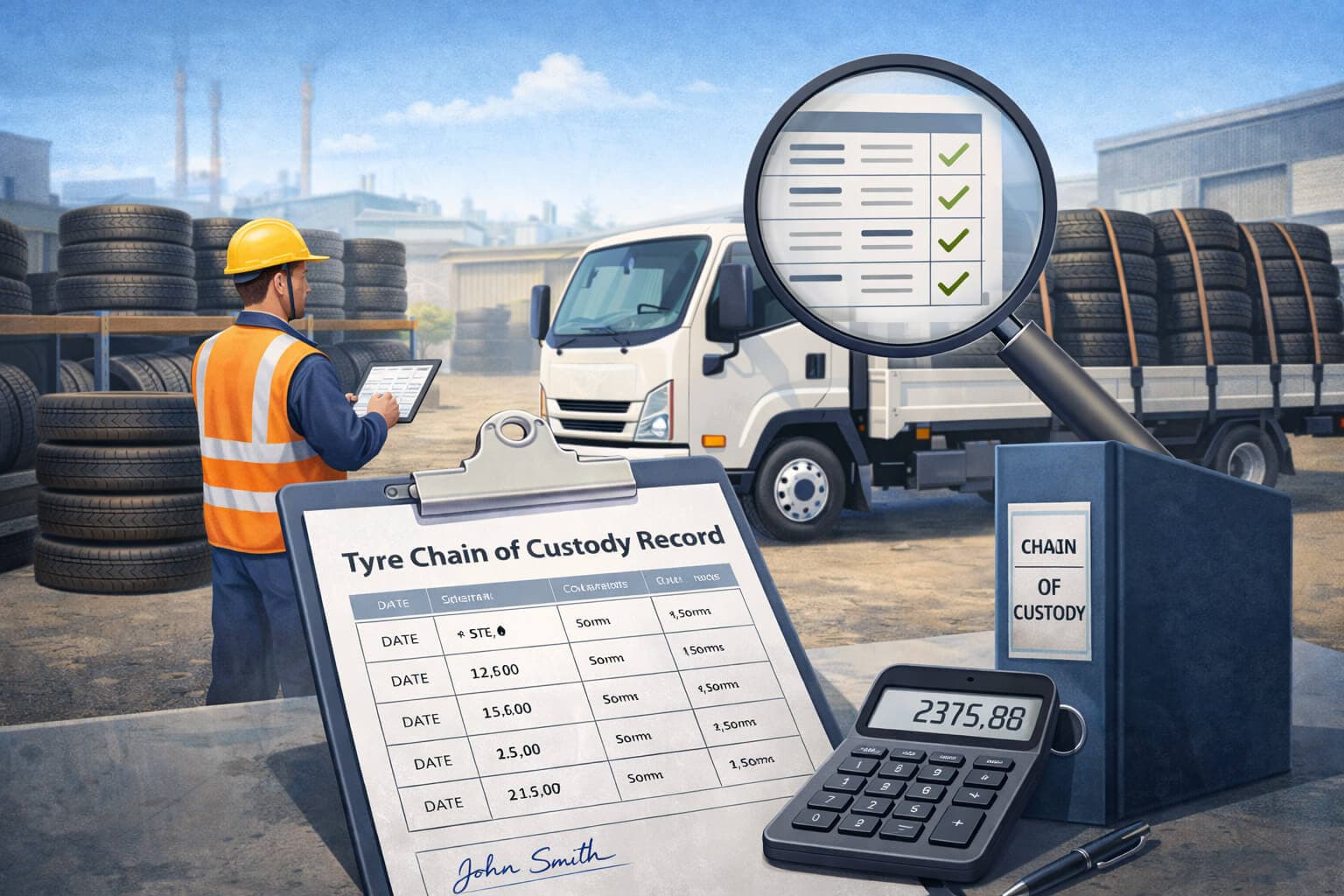
CoC isn't about complexity; it's about consistency. A defensible record trail should capture the 'who, when, where, and how' of every collection. At a minimum, your digital or physical ledger should include:
- The Transaction Trigger: The date and time the pickup was requested, linked to your internal volume threshold.
- Site-Specific Staging Data: Which bay or zone the tyres were collected from, including any site-ready audit results.
- Verified Volume Metrics: A standardized count (passenger units or weight) as agreed upon at the point of load.
- Collector Credentials: Confirmation of the collection partner's license and the specific vehicle registration used for transport.
- Receiving confirmation: A docket, receipt, or written record identifying the facility that accepted the tyres and the date of delivery.
Chain of Custody as a Sales Tool
Increasingly, large fleet operators, government agencies, and corporate clients are demanding high environmental standards from their service providers. If you can't prove where your waste goes, you may be excluded from high-value contracts.
A consistent chain-of-custody process gives fleet customers and procurement teams a clearer view of how used tyres leave the site. Keep the claim limited to what the records show: collection details, transporter information, receiving destination, and any confirmed recovery outcome.
Moving from 'Scattered' to 'Systematic'
The biggest enemy of CoC is the 'Lost Log.' When records are kept on loose paper or buried in an owner’s personal email, audits become a nightmare. Successful NSW businesses use a centralized, digital-first approach:
- Appoint a Compliance Lead: One person who ensures every truck driver signs off on the count and provides a receipt.
- Digitize on the Spot: Use simple tools to photograph receipts or load counts immediately, uploading them to a shared cloud folder.
- Audit Your Partner: Periodically ask your collection partner for their downstream recovery reports. A professional partner like ATR welcomes these inquiries.
- Link to Your Schedule: Use your recurring pickup cadence to check your records. If a scheduled pickup happened, there should be a corresponding CoC entry.
Secure Your Audit Readiness
Chain of Custody doesn't have to be a headache. With the right partner and a simple routine, it becomes your most powerful business shield.
See how our Sustainability Reporting supports your CoC goals, or request a sample compliance pack to see what a professional record trail looks like.
Next Step: Ensure your site is ready for the next documenting pickup with our Site Prep Checklist.
Common Questions
Frequently asked questions
What does tyre chain of custody mean?
It is the record trail connecting the business that releases the tyres, the transporter, the collection event, and the facility that receives the load.
What information should a tyre chain-of-custody record contain?
Include origin, date and time, quantity, transporter and vehicle details, receiving destination, and supporting dockets, invoices, or tracking references where applicable.
Why should NSW businesses check the receiving destination?
The waste generator should be able to show that tyres were taken to a place that could lawfully accept them, rather than relying only on a verbal assurance from a collector.
Next Step
Turn the guidance into a workable pickup plan
If you are reviewing tyre collection providers, compare the commercial tyre pickup services, the dedicated used tyre collection NSW page, or the broader tyre disposal for businesses NSW page. You can also request a site-specific collection plan through ATR contact, or review local coverage for Sydney, Newcastle, Wollongong, Central Coast, and Blue Mountains.