Practical Guide
This article is written for NSW tyre shops, workshops, dealers, warehouses, and fleet depots that want cleaner operations, easier pickups, and stronger compliance routines.
Beyond the Green Horizon
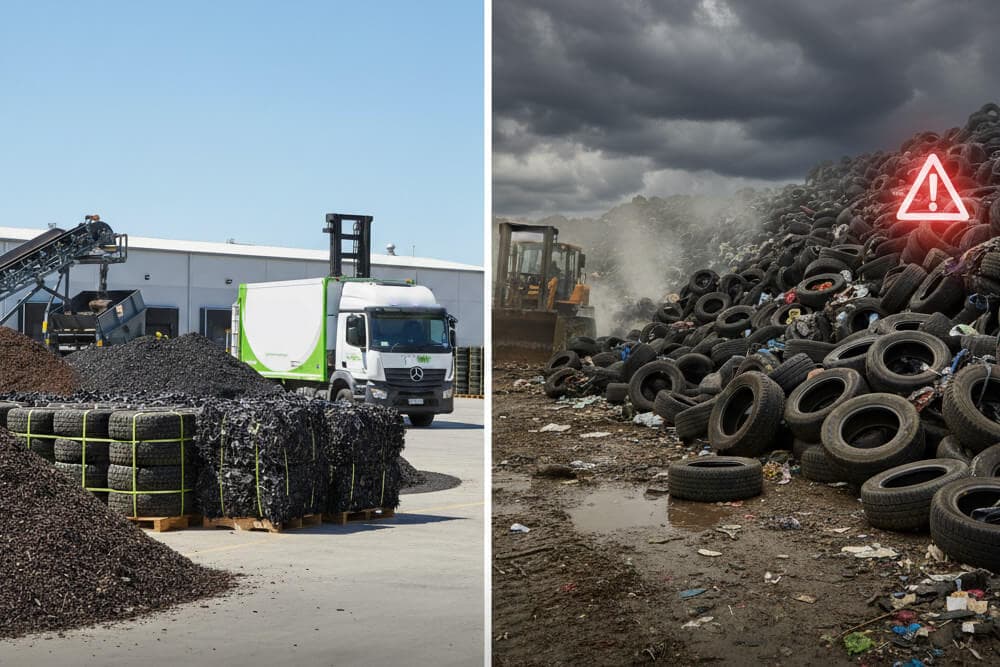
For decades, the conversation around end-of-life tyres in NSW has been split between 'landfill' and 'recycling.' For a commercial operator, this choice is often presented as a moral one. However, in the modern business landscape, the choice is actually strategic. The impact of your disposal route extends far beyond a carbon footprint—it affects your liability, your brand value, and your eligibility for high-tier commercial contracts.
Recycling isn't just a sustainable alternative; it is a superior logistical pathway. When you choose recovery over disposal, you are choosing to participate in a circular economy that values your waste as a raw material, rather than a permanent environmental debt.
Landfill: The Hidden Liability
While landfilling tyres was once standard practice, it has become a significant business risk. Tyres in landfill do not decompose; they take up massive volumes of space and can trap gases, leading to site instability and fire risks. In NSW, the regulatory environment is increasingly hostile to landfilling recoverable resources.
As a business owner, sending tyres to landfill leaves a permanent 'audit trail' pointing to an environmental dead-end. If regulations shift further or a landfill site experiences an issue, your business's past disposal choices can come under scrutiny. Recovery, by contrast, closes the loop and eliminates that long-term liability.
The Commercial Case for Resource Recovery
Why do the most successful tyre retailers and fleet operators in Sydney prioritize recycling? Because their customers demand it. High-value fleet clients, government agencies, and tier-one contractors increasingly require 'Sustainability Credentials' from their suppliers.
If you can demonstrate a 100% recycling rate for every casing you remove, you aren't just a mechanic or a dealer—you are a sustainable partner. This transparency is a powerful tool for winning and retaining premium contracts. In short, recovery is good for the planet, but it’s even better for your P&L.
Operationalizing Sustainability
The secret to moving from landfill-dependency to recovery-readiness is Operational Discipline. It starts with simple site habits:
- Clean-Stream Staging: Tyres that are free from dirt, metal, and debris are far easier to process into high-value raw materials (like crumb rubber or TDF).
- The Logistical Cadence: Using a scheduled pickup routine ensures that your tyres move through the recycling facility in a steady stream, rather than in 'bursts' that can overwhelm processing capacity.
- Demand Documentation: Professional recyclers provide the traceability reports you need to prove your impact to your stakeholders.
Leading the Circular Transition
The transition from waste to resource is the defining shift of our generation. By choosing recovery today, you are future-proofing your business for tomorrow.
Learn more about our Recycling Technology, explore our Commercial Recovery Services, or speak with a sustainability expert to audit your site's environmental impact.
Next Step: Ensure your site records are up to standard with our Chain of Custody Guide.
Next Step
Turn the guidance into a workable pickup plan
If you are reviewing tyre collection providers, compare the commercial tyre pickup services, request a site-specific collection plan through ATR contact, or review local coverage for Sydney, Newcastle, and Wollongong.